A journey through Poland — cobblestones, castles, pierogi, and the quiet weight of a nation that has survived everything. Traveling to Poland offers a unique experience and a deep connection to its rich history.

The Cities: A Grand Tour Reimagined
Poland’s cities are its greatest argument. Each one is distinct enough to feel like a different country entirely — connected by rail, separated by centuries of individual identity.
Traveling to Poland means discovering its cities, each offering a unique narrative and a glimpse into its vibrant past.
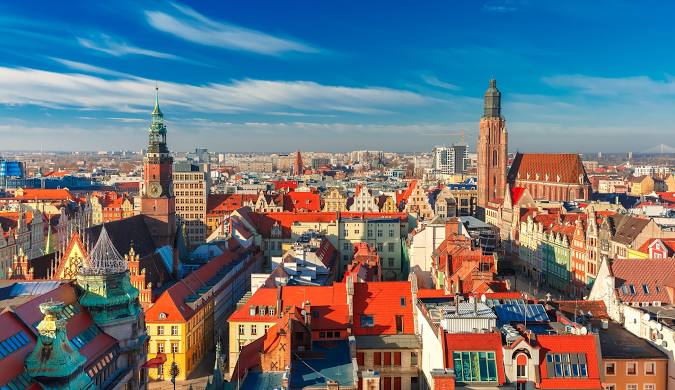
Straddling the Oder river across a dozen islands, Wrocław is perhaps Poland’s most immediately charming city. Its Gothic town hall is among Europe’s finest, and the city’s 300+ bronze dwarfs hidden around every corner delight even the most jaded traveler.
A Baltic jewel of merchant gables and amber light. Gdańsk sits at the intersection of Polish and Germanic history — it is where World War II began, and where Solidarity ended communist rule. The Long Lane at golden hour is unforgettable.
For anyone traveling to Poland, Gdańsk is a must-see, with its rich history and stunning architecture that tells tales of resilience.
Beyond these four, Poland rewards the curious traveler with Poznań’s Renaissance square, the thermal spas of Zakopane at the foot of the Tatras, and the vast, primeval silence of Białowieża Forest — one of the last old-growth forests in Europe, home to free-roaming European bison.
Traveling to Poland is also about enjoying the stunning landscapes, from the Tatra Mountains to the serene Białowieża Forest.
What to Eat: An Honest Account
Polish food has suffered from unfair caricature — heavy, grey, a thing to be endured rather than savored. Ignore this entirely. The cuisine is, in fact, one of the great pleasures of a trip here: deeply comforting, technically honest, and built on ingredients of startling quality.
While traveling to Poland, don’t miss out on savoring the local cuisine that reflects the heart of Polish culture.
The Essentials
Pierogi are the non-negotiable starting point — soft dough dumplings filled with potato and cheese (ruskie), sauerkraut and mushroom, or sweet farmer’s cheese with a dollop of sour cream. A plate in a milk bar costs almost nothing and will sustain you for hours.
Żurek, a sour rye soup served in a hollowed bread bowl with a hard-boiled egg and sausage, is the breakfast of champions on a cold morning.
Bigos — hunter’s stew of sauerkraut, fresh cabbage, and various meats — tastes best on day three of reheating, which is precisely how every Polish grandmother makes it.
When traveling to Poland, be sure to try the famous pierogi, a dish that embodies the spirit of Polish comfort food.
Beyond the classics: smoked oscypek cheese from the mountains, grilled over coals and served with cranberry jam. Craft beer, which has undergone a remarkable renaissance in the last decade. And zapiekanka — a toasted baguette half laden with mushrooms, cheese, and ketchup, sold from windows in Kraków’s Nowy Plac square, eaten standing up at midnight. It should not work. It absolutely does.
- Breakfast — Żurek (sour rye soup) or open-faced bread with twaróg cheese and chives
- Lunch — Pierogi ruskie with sour cream; a glass of kompot (fruit drink)
- Dinner — Bigos with dark rye bread; Polish craft lager from a local brewery
- Late night — Zapiekanka at Nowy Plac, Kraków (cash only, queue expected)
- Sweet — Pączki (filled doughnuts) dusted with candied orange peel
History: The Weight and the Wonder
To travel in Poland without engaging its history is to skim the surface of one of the most extraordinary national stories in the world. This is a country that was partitioned off the map for 123 years, rebuilt its capital from wartime rubble, survived Nazi occupation and Stalinist repression, and then, in 1989, helped bring down the Iron Curtain — largely through the force of a shipyard union and the moral authority of a Polish pope.
Traveling to Poland means engaging with a narrative of resilience and hope that has shaped the nation.
A visit to the Auschwitz-Birkenau Memorial outside Kraków is not tourism in any ordinary sense. It is an act of witness — somber, necessary, and profoundly humanizing. Equally moving is the POLIN Museum of the History of Polish Jews in Warsaw: a world-class institution that traces a thousand years of Jewish life in Poland with scholarship, sorrow, and immense dignity.
But Polish history is not only darkness. The Jagiellonian University in Kraków, where Copernicus studied, has been educating students since 1364. The Royal Castle in Warsaw, rebuilt stone by stone from historic photographs after wartime destruction, is one of the great acts of cultural defiance in history. In Gdańsk, you can walk the path that Solidarity ship workers walked — a story of ordinary courage that changed the world.
The journey of traveling to Poland is enriched by its profound history and the lessons it teaches about humanity.
When to Go & How to Move
Poland is a four-season destination. Spring (April–June) brings blooming chestnut trees, mild temperatures, and the country before the summer crowds. Autumn is arguably the finest time: cool amber light, the Tatra Mountains blazing with color, harvest festivals in every region, and a contemplative quality to the shorter days. Winter in Kraków, with its Christmas markets and snow-dusted spires, has a fairy-tale quality that photographs can barely capture.
Traveling to Poland in spring unveils the beauty of blooming landscapes and cultural events that awaken the senses.
Getting around is genuinely easy. Poland’s intercity rail network — particularly the PKP Intercity express trains — connects the major cities quickly and affordably. Warsaw to Kraków in under three hours; Warsaw to Gdańsk in less than three. A rental car is worth considering for the countryside: the Małopolska region south of Kraków, the Masurian Lake District in the northeast, and the Bieszczady mountains near the Ukrainian border reward slow, unhurried driving.
When traveling to Poland, the ease of getting around makes it accessible for everyone to experience its diverse offerings.
- Currency — Polish złoty (PLN). Cards accepted widely, but carry some cash for markets and milk bars
- Language — Polish is notoriously difficult; English widely spoken in cities, less so in rural areas
- Getting around — PKP Intercity trains are excellent; book in advance for weekend travel
- Budget — Poland remains excellent value; a full sit-down dinner with drinks rarely exceeds €15–20
- Visa — EU/Schengen zone; most Western nationals enter without a visa
The Quieter Side: Beyond the Cities
The Poland that stays with you longest is not always in the cities. It is in a village in the Podhale highlands, where highlanders still wear embroidered folk costume at Sunday mass — not for tourists, but because they always have. It is in the wooden churches of southern Poland, a UNESCO-listed collection of vernacular timber architecture that feels like time travel. It is on a kayak in the Krutynia river, paddling through reed beds and birch forest in a silence so complete you can hear the water move.
For those traveling to Poland, the rural landscapes offer a peaceful retreat from the bustling cities.
It is, perhaps most of all, in the hospitality. Polish generosity to guests is legendary — and it is not performance. You will be fed more than you can eat, poured more than you should drink, and sent off with provisions for the road. This is a culture that takes the guest relationship seriously, as a matter of honor.
There is a Polish word — tęsknota — that roughly translates as a wistful longing, a nostalgia for something you may not even have lost yet. It is the feeling of missing a place before you’ve left it. Travel enough in Poland and you will understand exactly what it means.
Traveling to Poland evokes a sense of nostalgia and connection that lingers long after you leave.
Go. Go before everyone else figures it out. But go knowing that even then, Poland will have kept something back — some quieter wonder, some back-road discovery — that belongs only to those willing to look past the obvious.
Ensure that your experience while traveling to Poland is filled with adventures and discoveries that go beyond the ordinary.