
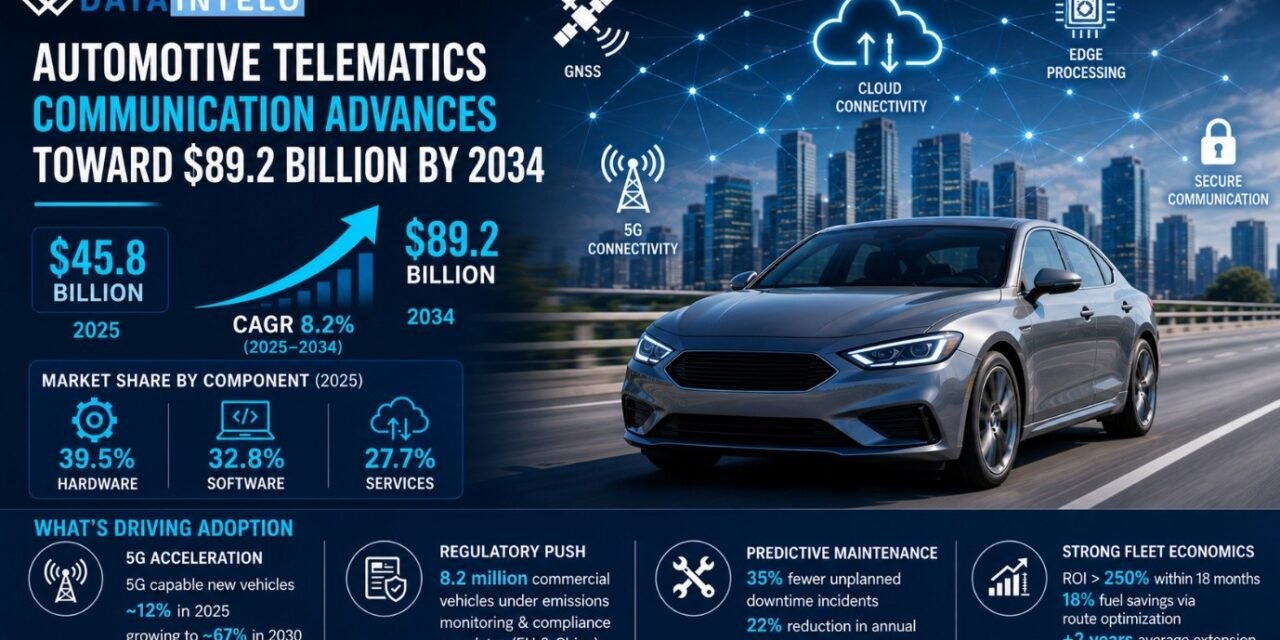
The wiring diagram of the modern vehicle has quietly become a communications network. Every new vehicle being churned out by a factory assembly line today comes equipped with a blend of technologies, such as cellular modems, GNSS, edge processors, and cloud connections. These technologies were still considered cutting-edge just a decade ago but are inching closer to being taken for granted today. This is reflected in the figures: the global automotive telematics communication systems market, estimated to be worth $45.8 billion in 2025, is set to grow to $89.2 billion in 2034 at a CAGR of 8.2%, according to a new study from Dataintelo.
While the actual figure is not of much interest to the fleet manager, the OEM strategy team, and supply chain executive, it is the factors behind it that matter most. This is not the tale of one breakthrough technology. This is the tale of how three different things converged on the industry near each other—5G rollout, stricter safety and emission rules, and the economic viability of predictive analysis.
An Industry Reorganizing Around Software and Services
Telematics has historically been sold as hardware: a modem, a GPS chip, a control unit bolted into the dash or the engine bay. That remains the biggest segment, as the hardware sector comprises an expected share of 39.5%. However, the growth narrative is being taken over by software (32.8%) and services (27.7%), where the latter sees a compounded annual growth rate of 10.5%, due to a transition from selling equipment to subscription and PaaS models.
This is relevant strategically. The competitive advantages of a hardware-focused telematics company will revolve around economies of scale in production and unit cost, a battle which has seen the unit cost of hardware reduce from $2,400 in 2015 to $680 in 2025 due to increased integration of semiconductors. On the other hand, a software-based telematics business will rely on the ability to generate high-quality data and make decisions based on the same. Telematics companies capable of doing both, such as Bosch and Continental AG, view telematics not as an additional component but as the connection layer beneath self-driving technology.
The Actual Factors Behind Adoption
While 5G facilitates faster data transmission speeds, it also transforms telematics. The upgrade of 4G LTE-V to 5G NR technology provides sub-100 millisecond latency, which is necessary for real-time communication between the vehicle and the infrastructure and also assists the driver. According to reports, telecom companies such as Vodafone, Deutsche Telekom, and China Mobile intend to spend more than $200 billion on 5G automotive spectrum and infrastructure by 2028. In developed markets, penetration of 5G enabled new vehicles is expected to reach 12% in 2025 and increase to 67% in 2030.
Regulation is not a contextual variable; it is now part of the design constraints. The eCall mandate of the EU mandates emergency communications capabilities in vehicles. China’s New Energy Vehicle program mandates that fleet real-time data be transmitted to the government’s systems. In the United States, NHTSA has been working on setting up performance standards for DSRC and cellular V2X technologies for vehicle-to-vehicle safety communications. There is now a fourth layer of regulation that has been added to the existing telematics mandate for emissions monitoring and reporting in the EU and China, affecting 8.2 million commercial vehicles.
Prediction-based maintenance has moved from a pilot project to being one of the purchase criteria. Those operators who work with AI-based diagnostics for their fleets have already noticed a remarkable increase in performance of their businesses. There was 35% less downtime and 22% savings per year on fleet maintenance thanks to the machine learning algorithms based on the data received from the engines, transmission, brakes, and batteries of the cars. Bosch and Denso are moving their computations to the edge—processing all the data locally, within the telematics control unit, instead of sending it directly to the cloud—which is claimed to reduce the necessary bandwidth by about 68%.
Fleet economics are fast becoming something that cannot be overlooked. While costs associated with hardware have come down and cloud analytics have matured, this research report states that commercial fleet operators are realizing ROI above 250% in under 18 months from telematics installations. Fuel savings through route optimization account for 18%, while predictive maintenance extends the useful life of the vehicle by 2 years on average. It is this economic model that has made the retrofitting aftermarket component, i.e., fleet telematics systems for vehicles without onboard systems, the fastest growing part of the business.
Where the Growth is Occurring
As the leader in terms of scale and momentum, the Asia Pacific region is projected to account for 42.3% market share in 2025 (market size of approximately $19.4 billion). This is due to China being the world’s leading producer of vehicles, development of 5G technology, and telematics systems being integrated into cars by manufacturers such as BYD, Geely, and GAC Aion. Such leadership will continue through 2034 with the Asia Pacific region having 43.8% market share thanks to NEV growth and smart city mandates.
North America (28.7% market share) will be driven more by regulations and insurance policies rather than manufacturing capacity—V2X guidance by NHTSA, connectivity spectrum allocation by FCC, and state-level AV guidelines will influence fleet adoption. Usage-based insurance services provided by Generali, Allianz, and State Farm will make telematics solutions available for the mass market, affecting well over 15 million insured vehicles around the world (and reaching 38.4 million by 2020) 2030).
However, Europe’s position is unique since here, there is a conflict between regulations and the temptation of the premium market. This is evident from the fact that BMW, Mercedes Benz, and Porsche make use of telematics because it gives them an edge over competitors.
Segment to Watch – Fleet Management, Then Safety
In terms of application segments, fleet management holds the most prominent position, accounting for 38.5% ($17.7 billion in 2025), which is consistent with the data on return on investment listed above, because that is where the most quantifiable business case can be found. But safety and security applications, accounting for 22.5%, have the highest compound annual growth rate, 8.7%, compared with 8.1% in fleet management. This is a trend worth watching out for OEMs’ product planners—it is mandate, rather than demand, that becomes the driver of growth in this segment, and this trend is accelerating beyond the EU.
The Problematic Aspects That Decision Makers Cannot Ignore
All of this does not come easily without difficulties. The telematics systems record data about the vehicle’s movement, behavior, and service needs. Consequently, they become increasingly attractive targets; according to the report, between 2022 and 2025, the number of connected vehicle cyberattacks will increase by 347%, and the EU GDPR fines imposed on the automotive industry may amount to $15 million. Moreover, new compliance concerns arise in China (the localization of data), India (the laws regulating the ownership of the vehicle’s data), and the US (FTC’s rules for data monetization from the vehicles).
In addition, there is a problem of platform fragmentation, where the top five OEM telematics platforms, including Mercedes-Benz, BMW, General Motors, Toyota, and Volkswagen, operate as closed ecosystems. This means that for fleet managers running mixed fleets, having an integrated system is impossible, and this partially explains why aftermarket telematics providers such as Geotab, Samsara, and Teletrac Navman have been successful despite lacking any manufacturer benefits.
Competitive Landscape
On the supply side, there is concentration but no stabilization, with fifteen major players having a combined market share of 74.2%. In the hardware category, the leader is Bosch, which controls 18.3% market share due to twenty-three production facilities and $1.2 billion worth of digital transformation initiatives per year. On the software side, Continental AG (13.7% market share) has established a competitive edge through twelve acquisitions made between 2018 and now.
In the connectivity space, carriers have begun acting like platforms rather than just infrastructure, as illustrated by the partnership of AT&T with Ford covering 8.2 million vehicles and the relationship of Verizon with General Motors involving 7.4 million. Finally, Chinese technology companies such as Baidu (in the form of the autonomous vehicle platform Apollo) and Alibaba (through the vehicular IoT offerings) are becoming a distinct competitive force, especially in any OEM strategy consideration of Asia Pacific involvement.
Decision Maker Implications
Whereas OEMs have to grapple with the choice of whether to include telematics in their vehicles, the decision has become less one of technology and more one of financial feasibility; the aftermarket market is becoming a more and more financially sensible area to enter, due to the reduced price of hardware. And as far as suppliers and carriers go, the opportunity will be moving up the stack, from merely providing connectivity to providing the analytics, cybersecurity, and edge-computing that can be provided on top of it.
The figure of 8.2% is an important headline to make note of, but even more interesting is what drives that growth, specifically services over hardware; fast-growing safety and security applications due to regulatory pressure; and faster aftermarket adoption than OEM deployments due to decreased costs. Companies that look at telematics as merely a compliance issue may find themselves underestimating the opportunity in the coming years.
Reference: https://dataintelo.com/report/automotive-telematics-communication-system-market